In Journal Square, the Skyline Is Growing. The For-Sale Market Isn't.
September 24, 2026
September 24, 2026
Search "Journal Square condos" on any portal this month and the median price will look like an invitation. Somewhere around $550,000, depending on the week you check, sitting well below Downtown Jersey City, The Heights, or Hoboken. It reads like a neighborhood in the middle of a boom, priced for buyers who got in before everyone else noticed the cranes.
Then you look at what's actually for sale, and the picture shifts. As of July 2026, roughly 48 condos were listed in Journal Square, ranging from $215,000 to $1.325 million, with a median closer to $550,000 and typical time on market of about 46 days. Almost none of them are inside the buildings you'd recognize from the skyline. That's not a coincidence. It's the whole story.
Journal Square is in the middle of one of the largest construction waves in Jersey City's history, and nearly all of it is rental.
Journal Squared, the KRE Group's three-tower complex next to the PATH station, added its third and final 60-story tower with 598 units, bringing the full project to roughly 1,840 rental residences and 36,000 square feet of retail and restaurant space. Across the plaza, Kushner Companies' long-delayed One Journal Square finally broke ground and is now leasing: twin 64-story towers totaling 1,723 residential units, anchored by a Target and built around amenities like a rooftop pool and a bowling alley. Neither building sells a single unit. Both are rentals from the ground up.
The pattern holds down Summit Avenue. Panepinto Properties' 53-story Pathside at 499 Summit was slated to deliver 605 rental apartments by the first half of this year, part of a wave of Journal Square projects a Panepinto executive pegged at $2 billion in real estate investment back when the tower broke ground in 2023. A few streets over, Oestreicher Properties' 622-unit Greyson is on the same 2026 delivery calendar, also built as a rental hold. Even the city's splashiest cultural announcement, the Centre Pompidou satellite museum planned alongside the Artwalk Towers at 808 Pavonia, is wrapped around residential towers whose scale runs into the hundreds of units.
Add it up and you get a neighborhood absorbing thousands of new homes without adding meaningfully to its condo inventory. The buildings people photograph when they talk about Journal Square's transformation are, almost without exception, buildings you can't buy into.
This isn't a matter of developer preference so much as how the financing gets structured. Jersey City has leaned on long-term PILOT agreements, payments in lieu of taxes that [Better Blocks NJ](https://betterblocksnj.org/2026/03/17/three-myths-about-tax-abatements-exemptions-and-pilot-agreements-in-jersey-city/) says can run ten to thirty years, to bring large projects to sites in Journal Square and the West Side that wouldn't have penciled out under standard property tax treatment. For instance, [Jersey Digs reported](https://jerseydigs.com/701-newark-ave-jersey-city-tax-abatement/) that a 360-unit project at 701 Newark Avenue was approved with a 30-year tax exemption tied to $11.5 million in state affordable housing financing, part of a deal that included 90 designated affordable units and union labor commitments.
A PILOT deal like that works cleanly for a building collecting rent checks every month for three decades. It's a much harder fit for a condo building, which sells out its units, hands over the deeds, and stops generating a single revenue stream the developer can attach a long-term payment schedule to within a year or two of opening. That mismatch helps explain why so much of the capital pouring into Journal Square has landed on rental towers rather than for-sale product, even as the neighborhood's public narrative is entirely about ownership-style transformation.
As Multifamily Dive reported, Jersey City Mayor Steven Fulop described the pace of change here in plain terms, calling Journal Square "one of the best renaissance stories in the country" and pointing to the density of development packed into a few square blocks near the PATH station. He's not wrong about the scale. He's just describing a renaissance that, so far, is mostly a rental one.
If the new towers aren't setting the for-sale median, something else is, and it's worth naming what. Ward C, the district that contains Journal Square, has the second-lowest homeownership rate in Jersey City at roughly 24 percent as of this year's local housing data. More than a third of its housing stock was built before 1940, prewar walk-ups and small multifamily buildings that make up the bulk of what actually trades hands.
That's the inventory setting your comp set. When a listing agent prices a unit in Journal Square, they're weighing it against a renovated pre-war three-family or a decades-old co-op, not against a unit inside Journal Squared or One Journal Square, because those units were never on the sale side of the ledger to begin with. The $550,000 median isn't a discount on new construction. It's the going rate for older buildings in a neighborhood whose new construction happens to be invisible to condo buyers.
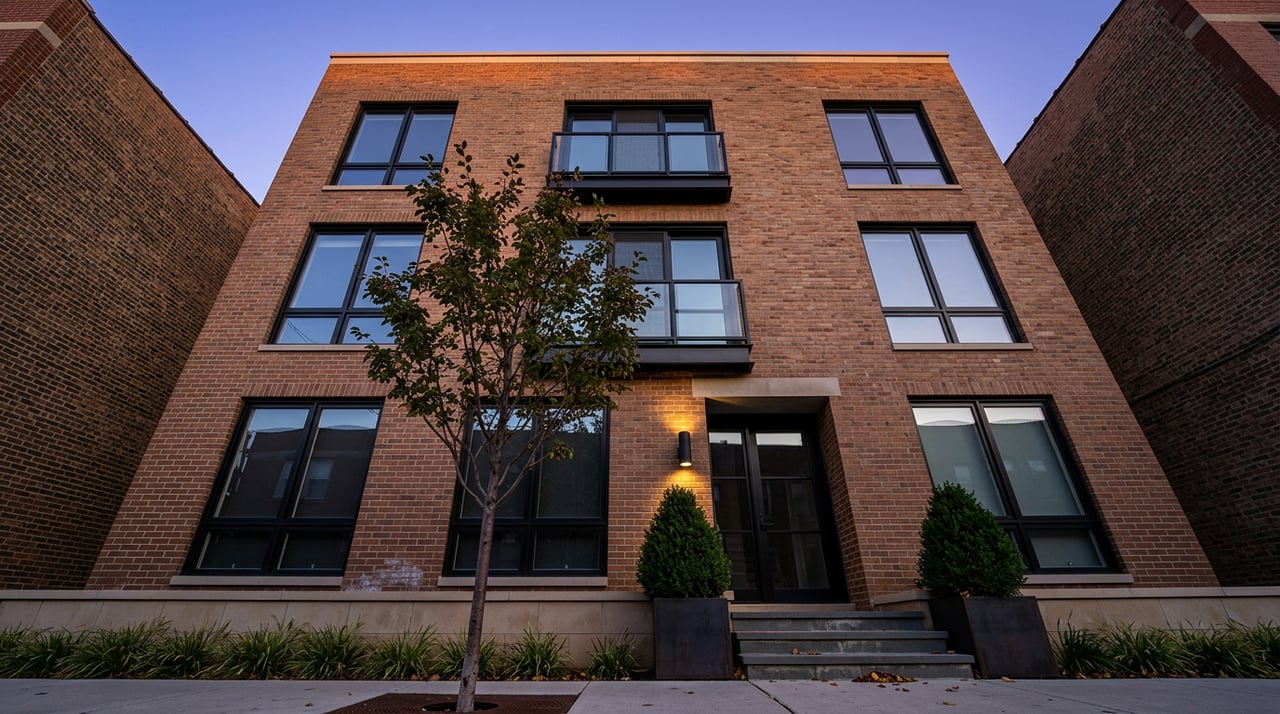
The exception proves the rule. A handful of small, ground-up condo projects have appeared on streets just off the main PATH corridor, built at a scale that never needed a thirty-year PILOT to pencil out. The condos at 68 Jordan, a half mile from the Journal Square PATH station, were down to their last unit as of this summer: a first-floor three-bedroom with a private backyard, quartz waterfall counters, and 400-series Andersen windows, priced for a buyer who wants new construction without the tower financing behind it.
That's the shape of Journal Square's actual for-sale new construction right now. Small, boutique, priced individually rather than absorbed into a 600-unit rent roll. It's a real option, but it's a different product than the skyline suggests, and buyers who go in expecting a unit inside one of the glass towers will spend a lot of time confused about why none of those units ever show up in a search.
If you're weighing Journal Square against Downtown Jersey City, Hoboken, or The Heights on price alone, the comparison isn't apples to apples. Those neighborhoods built out much of their new supply as condominiums. Journal Square built its equivalent supply as rentals, which means the neighborhood's for-sale median is measuring an older, smaller slice of the market than its rental listings would suggest.
For a buyer, that has a practical consequence. The commute math, the PATH access, the walk to Newark Avenue's restaurants and India Square, all of that transfers whether you rent or buy. What doesn't transfer automatically is the ability to own inside the part of the neighborhood that's actually new. If living in one of the recent towers matters to you, renting may be the only way in for now. If owning matters more, the realistic path runs through a prewar building or one of the small boutique condo projects scattered through the neighborhood, not through the addresses getting the press coverage.
Either path can work. The mistake is assuming the median price and the new construction are describing the same market. Right now in Journal Square, they aren't.
Will any of Journal Square's new rental towers eventually convert to condos? Nothing in the current pipeline suggests it. Buildings financed with long-term PILOT agreements are structured around decades of rental income, which makes an early condo conversion financially awkward for the developer even if market conditions shifted.
Does a low homeownership rate mean Journal Square is a bad investment? Not on its own. It reflects the neighborhood's housing mix, heavy on prewar multifamily and new rental towers, more than it reflects demand. Investors buying small multifamily or condo units here are working in a market shaped by that mix, which is a different calculation than a straightforward appreciation bet.
Where should a buyer look if they want new construction they can actually own? Boutique, ground-up condo projects on the side streets off the PATH corridor, rather than the towers anchoring the skyline. Inventory is thin and moves fast, so timing and a clear sense of your must-haves matter more here than in neighborhoods with deeper condo supply.
If you're trying to figure out which version of Journal Square actually fits your plans, or how it stacks up against Downtown, Hoboken, or The Heights for what you're trying to do, Christine Ayubi can walk you through the real inventory behind the headline numbers. Let's Connect.
This article is general information, not legal, tax or financial advice. Consult a qualified professional about your situation.
Stay up to date on the latest real estate trends.

Whether buying or selling, Christine provides tailored strategy and dedicated support to help you move with confidence.